|
|
|
MARCH
28, 2003
|
ISSUE.
No. 9
|
2003
LONG SESSION
|
|
Published
every Friday during legislative sessions exclusively
for NCCBI members
|
Legislation offered in Senate regulating
size, purpose of future state bond issues
North Carolina has no plan for managing its debt or for
prioritizing its long-range capital needs, State Treasurer
Richard Moore said in pointing out that the state’s debt has
risen 75 percent over the past five years and debt service has
almost doubled. In a groundbreaking Debt
Affordability Study he issued, Moore said the state’s
debt load now stands at $3.29 billion and annual debt service
payments at $302.3 million. While those figures remain
relatively low compared to other states, their rapid rise
means the state should put in place systems for better
managing debt, Moore recommended.
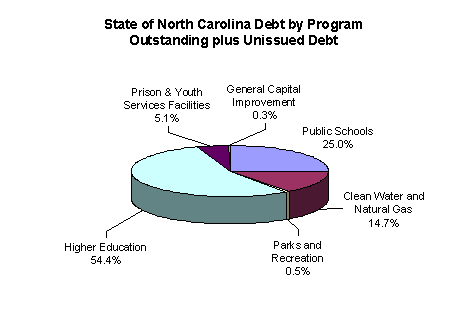
In his white paper, Moore said that the state’s current debt
load doesn't include $3.3 billion in bonds approved by voters
but not yet sold. Most of that -- $2.5 billion -- is the
remaining portion of the higher education bonds. The figure
also doesn’t include road bonds that are paid from dedicated
taxes. Assuming the remaining education bonds are sold as
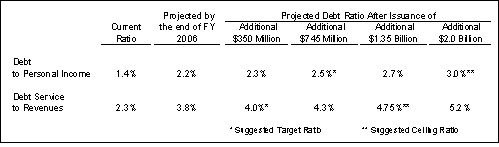
scheduled by 2006, the state's annual debt payments will rise
to $540 million, Moore said. If the General Fund budget stood
at $16 billion by then (compared to $14.3 billion today), debt
payments would account for just over 3 percent of state
spending, he added.
Sen. David Hoyle (D-Gaston) responded by introducing S. 464
An Act to Create the Debt Affordability Advisory Committee and
the Capital Projects Priority Committee. The legislation,
which was referred to the Appropriations Base Budget
Subcommittee, calls for a target debt-service-to-tax-revenue
ratio of 4 percent, with an absolute ceiling of 4.75 percent.
Under this formula and predictions of revenue growth, the
state could only take on another $350 million in total debt
before reaching the target number. NCCBI voiced its support
for the legislation in a note to the state Treasurer.
By passing the legislation, ”we can plan for North
Carolina’s future with a long-term perspective,” Moore
said, adding: “Implementing a best practices model for state
capital planning is not only prudent as we continue the trend
of increasing our debt load, but will also send a positive
signal to our credit rating agencies that we are always
looking for better ways to manage our state.”
Even with all the bonds sold by the state in the past five
years, North Carolina’s debt ratios remain below median
levels both for all 50 states and for a peer group of eight
Triple AAA rated states, Moore said. Expected future debt
issuances over the next four years total $3.3 billion, with
$2.55 billion or 77 percent issued for higher education
purposes.
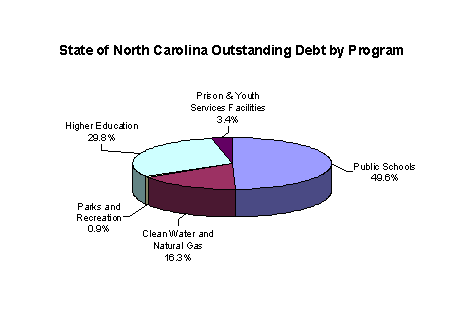
See charts below giving a breakdown of the state’s
outstanding debt.
Majority
in House backs major medical malpractice reform bill
A bipartisan majority of House members is co-sponsoring
a bill filed Thursday to protect patient access to health care
by tackling the professional liability insurance crisis facing
North Carolina’s doctors and hospitals. Lead sponsors of H.
809 Ensure Health Care Access include Reps. David Miner
(R-Wake), Edd Nye (D-Bladen), Joe Kiser (R-Lincoln) and Jim
Crawford (D-Granville). In all, the legislation has 72
co-sponsors. The legislation establishes a $250,000 cap on
non-economic “pain and suffering” damages, allows periodic
payments of future damages, places reasonable limits on trial
lawyers’ contingency fees and bars the use of nursing-home
inspection records in medical malpractice lawsuits. The bill
is more far-reaching than similar legislation introduced last
month in the Senate.
As detailed in a January cover story in the North Carolina
magazine, hospitals here have experienced increases of 400 to
500 percent in three years in their professional liability
insurance premiums. Doctors in key specialties, including
those with no past claims history, had insurance premium
increases of more than 50 percent last year. Many rural
hospitals are losing money and some may be forced to close and
some insurers have stopped writing coverage in North Carolina.
“Patients in Alleghany, New Hanover and other counties are
already facing access issues because increasing professional
liability insurance premiums are forcing their doctors to make
hard decisions,” said Dr. Joseph Jenkins, chair of the N.C.
Medical Society’s Professional Liability Task Force.
“Without reasonable reforms, will they be able to continue
to perform high-risk procedures, or even stay in practice.”
The U.S. Department of Health and Human Services has concluded
that a leading cause of the national insurance crisis is the
recent dramatic increase in jury awards and settlements. The
federal agency cited North Carolina and Nevada as states with
the most “mega” malpractice awards in recent years.
House
panel debates new controls on Medicaid drug costs
The
best way to control spiraling costs of the state Medicaid
program is to require that recipients receive only generic
rather than name-brand drugs, according to proposed
legislation debated Wednesday by the House Ways and Means
Committee. Under the bill offered by Rep. Paul Miller
(D-Durham), H. 233 (Miller) Medicaid Prior
Approval/Prescription Drugs, state health officials would
have to give their approval before any Medicaid recipient is
prescribed a brand-name drug. The committee, which did not
vote on the bill, heard testimony on three initiatives already
in place that officials said have saved the state $24 million
in Medicaid drug costs: The state requires doctors to obtain
prior approval before prescribing more than a dozen expensive
drugs. The Department of Health and Human Services capped the
reimbursements it will pay on some drugs. HHS also is working
with pharmacists to encourage the use of generic drugs.
Bill to
appoint state superintendent again surfaces in Senate
The Senate is again considering
legislation to amend the constitution to make the state
superintendent of public instruction an appointive rather than
an elective position. Sen. Wib Gulley (D-Durham), who
introduced S. 568 Superintendent of Public Instruction
Appointed, this week, said now is a good time to make the
change because incumbent Mike Ward has announced he won’t
seek re-election. The bill calls for a referendum in November
on allowing the governor to appoint the state superintendent.
Similar bills have passed the Senate on at least four other
occasions only to die in the House. Gulley said the many new
legislators this session gives him hope that the House will
approve the bill this time. NCCBI has long supported the
appointment of the state superintendent, as does Ward, Gov.
Mike Easley and several education groups, including the
Education: Everybody’s Business Coalition, the N.C. School
Boards Association, the Public School Forum, the N.C.
Association of School Administrators, the Business Committee
for Education and the Council of Local Chambers of Commerce.
The N.C. Association of Educators opposes the change.
Legislative Actions
 The
Senate on Wednesday gave second- and third-reading approval to
S. 338 (Queen)
Remove Sunset/Municipal Electric Service and sent the
bill to the House. The action came a day after the House
passed a similar bill, H. 356 (Tolson and LaRoque) Remove
Sunset/Municipal Electric Service, and sent it to the
Senate. The
Senate on Wednesday gave second- and third-reading approval to
S. 338 (Queen)
Remove Sunset/Municipal Electric Service and sent the
bill to the House. The action came a day after the House
passed a similar bill, H. 356 (Tolson and LaRoque) Remove
Sunset/Municipal Electric Service, and sent it to the
Senate.
The
House voted 116-1 on Tuesday to repeal a state law that allows
involuntary sterilizations of the mentally ill. H. 36 (Womble,
Luebke, Weiss and Insko) Repeal Involuntary Sterilization
now moves to the Senate for consideration.
The
Senate Judiciary II Committee on Tuesday favorably S. 353
(Bingham) Charitable Solicitations/Require Disclosure, a
bill that would require paid solicitors to immediately
disclose when asked how much of the money they raise for
charities actually goes to the charities. Current law now
requires solicitors to provide that information within 14 days
The
House Health Committee on Tuesday debated but took no action
on H. 346 (Moore) Emergency Generators/Nursing And Adult
Care Homes a bill that would require North Carolina's
adult care homes to have backup power generators. Discussion
indicated that committee members were surprised by how much it
would cost to require the nearly 1,400 facilities to acquire
the generators. Bill Warren, head of the construction section
for the state Division of Facility Services, said installing
generators and rewiring buildings to accept alternative power
sources would cost $5,000 to $8,000 for small adult care homes
and $50,000 to $75,000 for larger facilities.
The
House on Wednesday gave third-reading approval to H. 320 (McComas)
Internal Revenue Code Update and sent the bill to the
Senate.
The
Senate Finance Committee on Tuesday favorably reported S.
51 Close Franchise Tax Loophole and S. 100 State Govt.
Sales Tax Exempt.
Bills of Interest Introduced This Week
H.
636 (Munford) Modernize Judgment Docking Laws - An act to
give effect to electronic judgment dockets by modernizing laws
regarding judgments and reestablishing the effective date of
civil judgment liens and the date from which interest accrues
on judgments.
H.
637 (Munford) Amend Special Powers/Settlor of Revocable Trust
- An act to permit the settlor of a revocable trust to relieve
the trustee of duties, restrictions and liabilities imposed by
the Uniform Trusts Act.
H.
640 (Clary and Barnhart) Phase Out County Share of Medicaid
- An act to phase out the county share of the nonfederal share
of medical assistance program costs.
H.
641 (Clary and Barnhart) Phase Out County Share/State-County
Special Assistance - An act to phase out the county share
of the costs of the state-county special assistance program.
H.
642 (Wood) Conscience Protection/Contraceptives - An act
to provide effective conscience protection in insurance law
pertaining to coverage for prescription contraceptive drugs or
devices and for outpatient contraceptive services.
H.
643 (L. Allen) Railroads To Pay Some Nonbetterment Costs -
An act to require railroad corporations to pay some
nonbetterment costs for the movement of utilities.
H.
649 (Wood) International Home Furnishings Market -
An act to appropriate funds for capital improvements and
transportation needs of the International Home Furnishings
Market.
H.
654 (Alexander) Mental Health/Chemical Dependency Parity -
An act to require parity in health insurance coverage for
mental illness and chemical dependency.
H.
659 (Nye) Funds To Increase Adult Care Home Rates -
An act to appropriate funds to increase the rate paid to adult
care homes under the state-county special assistance program.
H.
664
(Insko) Local Option Tax Menu -
An act to authorize additional revenue options for local
governments.
H.
668 (Wright) New Hanover County Occupancy Tax - An act to
modify the city of Wilmington and New Hanover County beach
towns occupancy tax acts.
H.
669 (Wright) Hospital Licensure/Critical Access Hospital -
An act to amend the definition of a "primary care
hospital" to reflect federal requirements.
H.
674 (Luebke) Durham Northern Loop Corridor - An act to
amend the Highway Trust Fund Act description of the Durham
Northern Loop.
H.
677 (Rayfield) Reduce Sales Tax on Funerals - An act to
reduce the sales and use tax on funeral expenses.
H.
678 (Glazier) Eliminate High School Exit Exam - An act to
eliminate the high school exit exam and restrict the State
Board of Education from developing any further standardized
tests that are not required to fulfill the No Child Left
Behind Act of 2001 or other Federal Law.
H.
679 (Weiss) Raleigh/Wake Clear-Cutting - An act
authorizing the city of Raleigh and Wake County to limit the
clear-cutting of trees in buffer zones prior to development
and allow for the protection of specimen trees during the
development process.
H.
684 (Crawford) Psychiatric Hospital Bonds - An act to
provide a statutory framework for the financing of capital
facilities by the state, to authorize the issuance of special
indebtedness to finance the construction of a new psychiatric
hospital in Butner, and to authorize the issuance of special
obligation bonds for the construction of the new psychiatric
hospital.
H.
687 (Culpepper) BOG Nominations - A house resolution to
establish the procedure for nomination for election of members
of the board of governors of the University of North Carolina.
H.
689 (Glazier) Conform Evidence Rule 103 - An act
conforming Rule 103 of the North Carolina Rules of Evidence to
the corresponding federal rule.
H.
692 (Mitchell) Auto Auctioneers-No Dealer License Needed -
An act to provide that license auctioneers conducting auctions
for motor vehicle dealers do not need motor vehicle dealer
licenses.
H.
698 (Gibson) Monroe Prepared Food Tax - An act to
authorize the city of Monroe to levy a prepared food tax.
H.
726 (Rayfield) Establish Mountain Island State Forest - An
act to appropriate funds for the capital and operational costs
of establishing the Mountain Island Educational State Forest
to be located in Lincoln and Gaston Counties.
H.
729 (Gorman) Stoplights on U.S. Highway 70 - An act to
prohibit the Department of Transportation from installing any
additional stoplights on certain portions of U.S. Highway 70.
H.
736 (Miller) Durham Auto Tax - An act to authorize the
city of Durham to collect a general municipal vehicle tax of
up to $10 on vehicles resident in the city.
H.
738 (Miller and Hunter) Clean Water Management Trust Fund
- An act to amend the laws regarding the Clean Water
Management Trust Fund by including in the list of eligible
grant applicants certain nonprofit corporations whose primary
purpose is the promotion of health, welfare and safety or
socio-economic improvement of economically distressed
communities and by modifying qualifications, powers and duties
of the trustees of the fund. (=S. 551)
H.
740 (C. Wilson) Job Growth Accountability Act - An act to
improve the effectiveness and efficiency of the Economic
Development Board in the formulation of the state's economic
development policies and to provide for greater transparency
and accountability on the state's efforts to create jobs for
North Carolina citizens.
H.
744 (Hackney) Managed Care Patient Assistance - An act to
require insurers to inform covered persons about assistance
available from the Managed Care Patient Assistance Program.
H.
749 (Owens and Justice) Local Option Tax Menu - An act to
authorize additional revenue options for local governments.
H.
753 (Culpepper) House Joint Resolution - A House
resolution providing for election of members of the Board of
Governors of the University of North Carolina.
H.
787 (Mitchell) Reporting By Federal PAC - An act to
establish equity in reporting requirements between federal
political committees and North Carolina political committees.
H.
804 (Insko, Luebke and Womble) Earned Income Tax Credit -
An act to create a state earned-income tax credit.
H.
806 (Tolson) Rebate And Grant Program For AFVS Rebate - An
act to establish an alternative fuel and alternative fuel
vehicle rebate and infrastructure grant program.
H.
814 (Luebke, Bordsen and Insko) Increase Alcohol Excise Tax
- An act to restore the previous rate of excise tax on liquor;
to allow for sales of higher-alcohol content malt beverage; to
raise beer and wine taxes; and to direct a portion of the
proceeds of these tax increases to substance abuse treatment.
S.
520 (Dalton) Revenue Laws Property Tax Study -
An act to require the property tax subcommittee of the Revenue
Laws study committee to study the valuation of partially
improved, undeveloped lots in subdivisions.
S.
524 (Rand) Aggregates & Asphalt Tax Uniformity - An act to equalize the sales tax on aggregates and on asphalt and
concrete.
S.
527 (Hartsell) Death By Vehicle - An act to create the offense of "Death by
Vehicle" and to provide that the offense shall be
punished as a Class I felony.
S.
534 (Dalton) Just Comp/Local Government Taking - An act to
require local governments to pay just compensation for removal
of lawfully erected buildings, structures, outdoor
advertising, or personal property and to authorize local
governments to enter into relocation and reconstruction
agreements with owners of nonconforming properties.
S.
536 (Hoyle) Small Business Ombudsman Office - An act to
establish the small business ombudsman office in the
Department of Commerce.
S.
537 (Rand) Amend Public Enterprise Customer Billing Privacy
- An act to exclude airports from the public enterprise
billing information privacy law.
S.
539 (Rand) State Bar Amendments - An act amending the law
governing the limited practice of out-of-state
attorneys-at-law and the operation of the Council and
Disciplinary Hearing Commission of the North Carolina State
Bar.
S.
540 (Hartsell) APA Rules/Economic Impact Review - An act
providing for a separate process requiring agencies to review
the economic impact of proposed rules on small businesses
before publishing the proposed text of the rule in the North
Carolina Register.
S.
556 (Hoyle) Regulate Ticket Brokers - An act to regulate
persons seeking to engage in business as ticket brokers and to
apply the privilege tax on amusements to services provided by
ticket brokers.
S.
560 (Rand) Amend Real Estate License Laws - An act
revising real estate licensing examination procedures,
clarifying continuing education requirements for real estate
licensees and enabling the Real Estate Commission to permit
limited commercial practice by nonresident real estate
brokers.
S.
566 (Rucho) Limit Covenants Not To Compete - An act to
provide limitations on agreements or contracts that limit the
rights of persons to do business or obtain employment in the
state.
S.
572 (Clodfelter) District Judge 8-Year Terms - An act to
amend the North Carolina Constitution to provide eight-year
terms for the District Court Judges.
S.
573 (Clodfelter) Managed Care Patient Assistance - An act
to require insurers to inform covered persons about assistance
available from the Managed Care Patient Assistance Program.
S.
574 (Clodfelter) Earned Income Tax Credit - An act to
create a state earned-income tax credit.
S.
589 (Kinnaird) Livable State Minimum Wage - An act
amending the Wage and Hour Act to raise the state minimum wage
to a livable wage.
S.
590 (Kinnaird) Moratorium On Soft Drink Contracts/Schools
- An act to place a moratorium on the authority of local
boards of education to enter into contracts for the sale of
soft drinks to students in public schools, and to appoint an
independent study commission to study the public health issues
and make recommendations regarding whether certain foods,
including soft drinks, should be made available to students in
public schools.
S.
593 (Albertson) Extend Swine Moratoria - An act to extend
the moratoria on construction or expansion of swine farms.
State Government
After
eight months, budget surplus continues edging up
Tax collections continue running a
little ahead of budget, with the General Fund now $27.3
million ahead of projections after eight months of the fiscal
year. The surplus grew by $10.6 million in February alone.
However, non-tax revenue was $56.4 million less than expected
in February, which drops the budget surplus from $83.7 million
to $27.3 million. The surprisingly strong performance of
corporate income taxes is a major reason for the surplus.
After eight months of the fiscal year the state has collected
$431.7 million in corporate income taxes against a budget of
$327.0 million. Franchise taxes also are stronger than
expected, at $231.0 million vs. a budget of $201.1 million.
Total tax and non-tax revenues through eight months amounted
to $9.29 billion against a budget of $9.27 billion. See the
chart below for a detailed look at the General Fund.
Economic Development
Study
cites weak leadership in economic development policy
Just days after Site Selection
magazine ranked North Carolina No. 5 in the nation in new
corporate location projects, a study by the Kenan Institute of
Private Enterprise was released that faults the state’s
economic development efforts as fragmented and suffering from
poor leadership. The study, requested last year by the General
Assembly, concludes that there is little coordination or
teamwork between the state Department of Commerce and the
seven regional economic development partnerships. Regardless
of magazine rankings, “there is a widespread concern within
the state that we can do better,” according to the study,
which was authored by Dr. Michael Luger and Leslie Stewart of
the Kenan Institute in Chapel Hill. “On a scale from one
equals exemplary to four equals weak,”: the authors said,
“the mean rating N.C. practitioners gave to the consistency
of recruiting marketing messages across the state was a
3.2.”
The study, entitled “Improving North Carolina’s Economic
Development Delivery System,” directs a good bit of
criticism at the Department of Commerce. After conducting
dozens of interviews, the authors concluded that “the
perception… is (Commerce) has not performed as a strong lead
agency.” Elsewhere, the study said “a common sentiment
among all groups we interviewed is that North Carolina does
not have the strength of leadership (in economic development)
it needs.” Mostly this affects just the attitude of those in
the economic development community, the authors said: “In
short, the evidence about North Carolina’s performance in
industrial recruitment and expansion is mixed.” For its own
good, the state should pay much less attention to magazine
rankings, the study said. “Many practitioners criticize the
methodology for this ranking as being driven by interests in
the commercial real estate profession rather than by the needs
of industry CEOs. Site selection consultants still see North
Carolina as having an attractive product but insufficient
incentives relative to other states. On a per capita basis,
our record of announcements shows us well behind South
Carolina and Virginia.”
Bank
unveils major investment in loan processing facility
BB&T Corp. said it would create
300 new jobs over the next three years in Eastern North
Carolina and invest $12 million in Wilson County with the
construction of a new loan-processing facility. The bank is
planning a 100,000-square-foot facility that will create jobs
averaging $32,000 in salary per year. The company will begin
construction in spring 2003 and plans to occupy the new
building in early 2004. BB&T Chairman and CEO John Allison
said “part of our mission at BB&T is to help make the
communities where we work better places to live. We’re
certainly excited to be creating jobs in a slow economy and
growing in the city we called home for nearly 125 years.” BB&T has $80.2 billion in assets and operates more than
1,100 branch offices in the Carolinas, Virginia, Maryland,
West Virginia, Kentucky, Tennessee, Georgia, Florida, Alabama,
Indiana and Washington, D.C. It is the 14th largest financial
holding company in the United States and the largest mortgage
lender in the Carolinas. The state invested $300,000 in the project through the
One North Carolina Fund. BB&T worked with the Wilson
County Economic Development Council, the City of Wilson,
Wilson County and the N.C. Department of Commerce Eastern
Regional Office on the agreement.
NCCBI News
Kirk
urges Greensboro leaders to lobby their legislators
Speaking to the governmental affairs committee of the
Greater Greensboro Area Chamber of Commerce, NCCBI President
Phil Kirk urged the group to keep in close touch with their
area legislators as he discussed the major issues facing this
session of the General Assembly. Kirk said he is cautiously
optimistic that the co-speakers arrangement in the House will
work more efficiently than if a single speaker had been
elected by one or two votes. "I am optimistic that there
are enough good people in both parties who want to do the
right thing," he said.
He said that
NCCBI had endorsed the key parts of the governor's legislative
agenda -- the line item veto, spending reductions of nearly
$900 million, session limits, implementation of the Efficiency
Study Commission recommendations, and had agreed not to oppose
a two-year extension of the half-cent state sales tax and
higher income tax on upper-income individuals.
"We have not endorsed a tax increase," Kirk
said. He also discussed medical malpractice liability reform,
transportation, budget reform, and enrollment funding
increases for education. Kirk was introduced by Jim Kelley of
Duke Power. NCCBI board members attending were Watts Carr, Tom
Beard, and Pat Sullivan.
In another recent speech to the Bank of America
Entrepreneurial Schools banquet in Greenville, Kirk challenged
the audience to continue to support high stakes accountability
as a way to improve public education. He praised teachers and
administrators for their hard work on a daily basis and also
lauded the business partners in their audience for their
support of money and time in improving the public schools in
Pitt County. He was introduced by Larry Seigler, the vice
chair of NCCBI's education committee. The Pitt County Board of
Education, Pitt County Education Foundation, and the
Greenville-Pitt County Chamber of Commerce presented Kirk with
a plaque saluting him for his service as the chairman of the
State Board of Education.
Board
members win prizes for membership recruitment
Several members of the NCCBI board
won prizes for their work over the past year to recruit new
members for the association. The drawings were held during the
Chair’s Reception held at the N.C. Museum of Art the evening
before the Annual Meeting. Below is a list of the donors, the
prizes and the winner. NCCBI wishes to thank the donors.
Angus Barn: $80 Gift
Certificate & Free Local Limousine Services by Midtown
Express ($100). Gordon Myers
Belk: Waterford
Crystal Vase. Kelly King
Biltmore Inn: 3 pack
of Biltmore Winery & Certificate for 2 for a 2 nights stay
at the Inn on Biltmore that includes tickets to tour the
Biltmore House, Biltmore Gardens & Biltmore Winery. Glenn
Ketner
Blue Cross & Blue Shield of N.C.: 4 Luxury Box tickets to the Carolina Hurricanes game, VIP
parking included. Russ Stephenson
Capel Inc.: $100
Gift Certificate good at any Capel Rug Outlet. Bradley
Thompson
Classic Gallery:
Certificate for one Ultra Suede covered chair. Horace
Johnson
Council Tool Co.:
2 five-pound Dayton pattern Velvicut axes, 1 Ground Hog
Cultivator Mattock, all forged from American steel and made in
Lake Waccamaw. Bruce
Biggs, Steve Miller
Duke
Energy: 2 Umbrellas. John Forlines
First Bank: $200
Savings Bond. Bob Lowe
First Citizens Bank: $100
Savings Bond. Will Spence
T.W. Garner Food Co.: Texas
Pete gift box. Steve Stroud
Grandfather Mountain: Log
Cabin weekend stay. Harold Wells
Hatteras Yachts: $100
Gift Certificate for Hatteras Merchandise. Avery Thomas
Lowe’s Motor Speedway: 2
tickets to the 2003 Winston, 2 tickets to the 2003 Winston
pole night and Hardees 200 Craftsman Truck Series Race. Jim
Nance
Martin Marietta: One-week
stay at a house in Sea Pines, Hilton Head. David Huskins
Miller Brewing Co.: Miller
Girl-in-the-Moon Clock ($50 value). Barry Eveland
News & Observer: 4
tickets to a Carolina Panthers game. Smedes York
Owen Manufacturing Co.: 1
blanket. Bill Johnson
Pepsi Bottling Ventures: Sierra
Mist golf bag. Jim Hyler
Shelco: 3 pack
of Shelton Vineyards Wine. George Little
Tryon Palace Historic Sites & Gardens: 2 adult gift certificates. Pat Corso
U.S. Trust Co. of North Carolina: Mont Blanc pen. Linwood Davis
Weyerhaeuser: Golf
shirt, golf umbrella, golf balls, wooden golf cart. Joe
Thomas
Names in the News
Four named
to N.C. State Board of Trustees
The UNC Board of Governors approved the following
appointments and reappointments to the board of trustees of
N.C. State University. Appointed to a first four-year term: Robert
B. Jordan III of Mount Gilead, the former lieutenant
governor who is a 1954 graduate of State. He is president of
Jordan Lumber & Supply and serves as a member of the
College of Management Board of Advisors. He replaces Ed Hood,
who served two four-year terms on the board. Cassius S.
Williams of New Bern, a State Farm agent who is a 1969
graduate of State. He has served two terms as president of the
board of directors of the Alumni Association, and currently
chairs the Alumni Association's Building Committee. Williams
had been appointed by the Board of Governors at its February
meeting to fill the unexpired term of Vernon Malone, who
resigned his seat on the board after his election to the state
Senate. Reappointed to a second four-year term: Ann B.
Goodnight of Cary, a 1968 graduate of State who handles
community relations at SAS Institute, founded by her husband,
Dr. James H. Goodnight. She serves on State's Capital Campaign
Executive Committee and also played a leadership role in the
Campaign for N.C. State Students. Wendell H. Murphy of
Rose Hill, a 1960 State graduate who founded and is chairman
of the board and CEO of MurFam Enterprises LLC. He previously
served as a trustee in 1993 but resigned to accept an
appointment to the Centennial Authority.
Rosemary
DePaolo, president of Georgia College and State
University, was confirmed as the new chancellor for UNC
Wilmington by the UNC Board of Governors. She will assume the
post on July 15, succeeding the retiring James R. Leutze.
DePaolo, a native of Long Island, has a bachelor's degree from
City University of New York and master's and doctoral degrees
in 18th century English literature from Rutgers. DePaolo
served as dean of the College of Arts and Sciences at Western
Carolina University before moving to her current job in
Georgia.
Courtney
Crowder of Raleigh was elected president of the Young
Democrats of North Carolina Club, the first African-American
to hold the post. Crowder, 26, managed Cong. Bob Etheridge’s
campaign last year.
Pamela
Thorpe Young of Cary was appointed by Gov. Mike Easley to
the North Carolina Industrial Commission, effective May 1. She
will fill the seat currently held by Renee Riggsbee. Young is
currently deputy secretary for the arts and libraries and
legal counsel for the N.C. Department of Cultural Resources.
She served on the Industrial Commission staff from 1996-2002.
|
Status
of the
|
February
|
Year-to-Date
|
|
General
Fund
|
Projected
|
Actual
|
Projected
|
Actual
|
|
|
|
|
|
|
| Individual Income
|
$283.8
|
$288.5
|
$4,871.6
|
$4,858.0
|
|
Corporate Income
|
-9.0
|
-16.2
|
327.0
|
431.7
|
|
Sales and Use
|
293.0
|
305.0
|
2,730.4
|
2,681.2
|
|
Franchise
|
33.2
|
31.3
|
201.1
|
231.0
|
|
Insurance
|
6.2
|
7.2
|
114.3
|
123.6
|
|
Beverage
|
14.5
|
14.7
|
114.2
|
112.8
|
|
Inheritance
|
8.8
|
7.0
|
69.6
|
79.9
|
|
Privilege License
|
1.3
|
0.7
|
30.7
|
27.7
|
|
Tobacco Products
|
3.9
|
3.3
|
30.1
|
28.6
|
|
Real Estate Conveyance Excise
|
1.8
|
1.8
|
10.0
|
10.0
|
|
Gift
|
0.3
|
0.3
|
1.8
|
2.7
|
|
White Goods Disposal
|
0.3
|
0.3
|
0.6
|
0.6
|
|
Scrap Tire Disposal
|
0.8
|
0.8
|
1.7
|
1.7
|
|
Freight Car Lines
|
—
|
—
|
—
|
—
|
|
Piped Natural Gas
|
6.3
|
11.0
|
34.8
|
32.0
|
|
Other
|
—
|
0.1
|
—
|
0.1
|
|
Total
Tax Revenue
|
$645.2
|
$655.8
|
$8,537.9
|
$8,621.6
|
|
|
|
|
|
|
|
Non-Tax Revenue
|
|
|
|
|
| Treasurer's Investments
|
9.7
|
10.6
|
77.2
|
75.8
|
|
Judicial Fees
|
12.0
|
12.0
|
88.7
|
80.2
|
|
Insurance
|
0.1
|
1.5
|
29.8
|
17.7
|
|
Disproportionate share
|
—
|
—
|
107.3
|
107.3
|
|
Highway Fund Transfer In
|
—
|
—
|
11.5
|
11.5
|
|
Highway Trust Fund Transfer In
|
94.4
|
94.4
|
283.1
|
283.1
|
|
Intra State Transfer In
|
—
|
—
|
—
|
—
|
|
Other
|
17.0
|
14.6
|
136.1
|
101.7
|
|
Total Non-Tax Revenue
|
$133.2
|
$133.1
|
$733.7
|
$677.3
|
|
|
|
|
|
|
|
Total Tax and
Non-Tax Revenue
|
$778.4
|
$788.9
|
$9,271.6
|
$9,298.9
|
|
|
|
|
|
|

|

