| Legislative
Bulletin |
APRIL
6, 2001 |
 |
Landmark
clean-air legislation emerges in the legislature
 Far-reaching
legislation introduced in the state House and Senate this week
would require the state's two largest electric utilities,
CP&L and Duke Power, to dramatically lower emissions of
nitrogen oxide (NOx) and sulfur dioxide from their 14
coal-fired power plants. The reductions would sharply lower
atmospheric ozone and go a long way toward eliminating the
haze often seen in the air in the western part of the state.
The utilities would have to invest hundreds of millions of
dollars in pollution-control equipment at the plants, with the
costs passed along to consumers. Far-reaching
legislation introduced in the state House and Senate this week
would require the state's two largest electric utilities,
CP&L and Duke Power, to dramatically lower emissions of
nitrogen oxide (NOx) and sulfur dioxide from their 14
coal-fired power plants. The reductions would sharply lower
atmospheric ozone and go a long way toward eliminating the
haze often seen in the air in the western part of the state.
The utilities would have to invest hundreds of millions of
dollars in pollution-control equipment at the plants, with the
costs passed along to consumers.
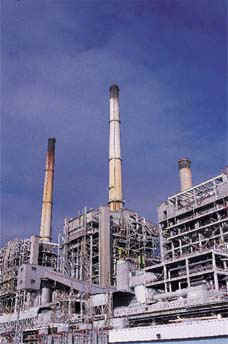
Left: CP&L's Roxboro plant is one of the 14 coal-fired
plants in the state.
The legislation, sponsored in the House by Rep. Martin Nesbitt
(D-Buncombe) and in the Senate by Sen. Steve Metcalf
(D-Buncombe), would require the utilities to slash sulfur
dioxide and nitrogen oxide emissions by roughly 70 percent
over the next 12 years. Officials at CP&L and Duke Power
say they can support the legislation, which would make North
Carolina a national leader in cleaning up the air.
The air-quality improvements at the 14 coal-fired power plants
mandated by the legislation are on top of reductions CP&L
and Duke Power agreed to make last October during proceedings
by the state Environmental Management Commission. The federal
EPA had required the state to submit a plan for sharply
reducing the amount of ozone-causing emissions coming from
North Carolina and blowing into Northeastern states.
"CP&L is committed to cleaning up North Carolina's
air, and we're demonstrating that commitment through our
efforts to reduce NOx emissions -- 40 percent in the last six
years," the utility said in a press statement. "If
North Carolina wants to adopt these new clean air standards
and aggressive timetable that far exceed both federal
regulations and what other states have done, this legislative
package is a way to accomplish that goal without jeopardizing
the reliability and affordability of electricity," the
statement continues.
Duke Power spokesman Joe Maher said the legislation "has
goals that are aggressive but achievable."
Reducing emissions from the 14 coal-fired power plants is half
of the state's two-pronged strategy toward cleaner air. The
state also is working to reduce emissions from cars and
trucks. Legislation passed two years ago stipulates that,
beginning in 2004, only low-sulfur gasoline can be sold in the
state. That law also tightens up on vehicle inspections and
extends the vehicle emissions testing law, which now is in
effect in the state's nine most urban counties, to 48 counties
over the next could of years. Legislation
was introduced this week that implements that two-year-old
law, including raising the fee for a vehicle emissions test
from $19.40 to $33.50.
Retrofitting the coal-fired power plants -- most of which are
30 years old or older -- will be expensive. "We
estimate it will cost our company $700 million above what we
have already committed to do (in the EMC proceeding last
fall), which is about $500 million," said CP&L
spokesman Keith Poston.
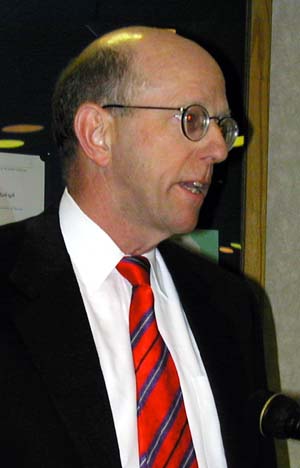 Bill
Ross (left), secretary of the Department of Environment and
Natural Resources, applauded the legislation. "An air
quality plan that produces significant reductions in nitrogen
oxide and sulfur dioxide emissions from North Carolina's
coal-fired power plants will help our environment, benefit
public health and improve our quality of life." Bill
Ross (left), secretary of the Department of Environment and
Natural Resources, applauded the legislation. "An air
quality plan that produces significant reductions in nitrogen
oxide and sulfur dioxide emissions from North Carolina's
coal-fired power plants will help our environment, benefit
public health and improve our quality of life."
"We applaud the effort of the involved parties --
legislators, energy companies and environmental groups, to
come up with a reasonable plan that accomplishes those goals,"
Ross added. "Significant nitrogen oxide and sulfur
dioxide reductions will also produce related benefits:
increased visibility, reduced haze, decreased ozone levels,
and reduced mercury and fine particulate emissions."
The legislation contains specific language directing the state
Utilities Commission to allow the utilities to recover from
their customers the money they invest in clean-air equipment.
"The commission shall allow each electric utility to
recover all just, reasonable and prudently incurred
environmental compliance expenditures through an environmental
compliance expenditure recovery factor that is separate from
the electric utility's rate base," the bill says.
"The commission shall set the environmental compliance
expenditure recovery factor for each utility at least
annually. The commission shall base the environmental
compliance expenditure recovery factor on the electric
utility's projections for its environmental compliance
expenditures for the next calendar year. The commission shall
incorporate into the environmental compliance expenditure
recovery factor determination the experienced under-recovery
or over-recovery of the electric utility's environmental
compliance expenditures incurred during the previous calendar
year," the bill further says.
Poston said CP&L estimates that recovering the investment
the utility will be required to make will raise the average
residential power bill by $5 a month. Commercial and
industrial customers, which use substantially more
electricity, would see much larger increases, he said.
Return to Page One
|
|
|
